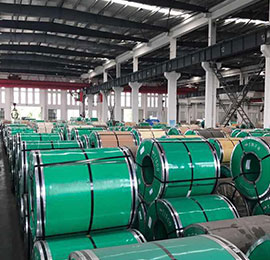
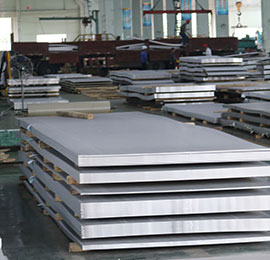
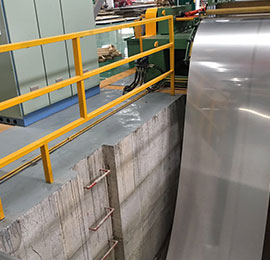
In layman's terms, stainless steel is steel that is not easy to rust. In fact, some stainless steels have both rust resistance and acid resistance (corrosion resistance). The rust resistance and corrosion resistance of stainless steel are due to the formation of a chromium-rich oxide film (passivation film) on its surface. This kind of rust resistance and corrosion resistance are relative. Tests have shown that the corrosion resistance of steel in weak media such as the atmosphere and water and oxidizing media such as nitric acid increases with the increase of the chromium content in the steel.
When the chromium content reaches a certain percentage, the corrosion resistance of the steel changes suddenly. , That is, from easy to rust to not easy to rust, from no corrosion resistance to corrosion resistance. There are many ways to classify stainless steel. According to the organization structure at room temperature, there are martensitic, austenitic, ferritic and duplex stainless steels; because stainless steel has excellent corrosion resistance, formability, compatibility and a wide temperature range The series of characteristics such as strength and toughness, so it has been widely used in heavy industry, light industry, daily necessities industry and building decoration industries.
Martensitic: Standard martensitic stainless steels are: 410, 414, 416, 416(Se), 420, 431 ss, 440A, 440B and 440C, which are magnetic; the corrosion resistance of these steels comes from "chromium", and its range It is from 11.5 to 18%. The higher the chromium content, the higher the carbon content is required to ensure the formation of martensite during heat treatment. The above three types of 440 stainless steel are rarely considered for applications that require welding, and the 440 type The composition of the filling metal is not easy to obtain.
Ferritic stainless steel (400 series) contains 15% to 30% chromium and has a body-centered cubic crystal structure. This type of steel generally does not contain nickel, and sometimes also contains a small amount of Mo, Ti, Nb and other elements. This type of steel has the characteristics of large thermal conductivity, small expansion coefficient, good oxidation resistance, and excellent stress corrosion resistance. It is mostly used for making atmospheric resistance. , Water vapor, water and oxidizing acid corroded parts. 420j2 stainless steel is a high-carbon steel with a minimum chromium content of 12%. The price of ferritic stainless steel is not only relatively low and stable but also has many unique characteristics and advantages. It has been proved that in many application fields where only austenitic stainless steel (300 series) can be used, ferritic stainless steel is an extremely excellent alternative material, ferritic stainless steel does not contain nickel. The main elements are chromium (>10%) and iron. Chromium is a particularly corrosion-resistant element for stainless steel, and its price is relatively stable.
Austenitic stainless steel refers to stainless steel with an austenitic structure at room temperature. When the steel contains about 18% Cr, 8%-25% Ni, and about 0.1% C, it has a stable austenite structure. Austenitic chromium-nickel stainless steel includes the famous 18Cr-8Ni steel and the high Cr-Ni series steel developed by adding Cr and Ni content and adding Mo, Cu, Si, Nb, Ti and other elements on this basis. Austenitic stainless steel produced by stainless steel factory is non-magnetic and has high toughness and plasticity, but its strength is low, and it is impossible to strengthen it through phase transformation. It can only be strengthened by cold working. If elements such as S, Ca, Se, Te are added, it has good properties. Machinability.
Duplex Stainless Steel (DSS) refers to stainless steel with ferrite and austenite each accounting for about 50%. Generally, the content of less phases needs to be at least 30%. In the case of low C content, the Cr content is 18% to 28%, and the Ni content is 3% to 10%. Some steels also contain alloying elements such as Mo, Cu, Nb, Ti, and N.
This type of steel has the characteristics of austenitic and ferritic stainless steel. Compared with ferrite, it has higher plasticity and toughness, no room temperature brittleness, and significantly improved intergranular corrosion resistance and welding performance, while still maintaining iron The 475℃ brittleness, high thermal conductivity, and superplasticity of element stainless steel. Compared with austenitic stainless steel, it has high strength and significantly improved resistance to intergranular corrosion and chloride stress corrosion. Duplex stainless steel has excellent pitting corrosion resistance and is also nickel-saving stainless steel.
What Is the Difference between 304 Stainless Thick-walled Pipe and Thin-walled Pipe?April 20, 2022I believe many people know that 304 material is generally used in some household appliances or water cups. It has excellent corrosion resistance and is safe. There are usually two types of 304 stainle...view
How Long is the Service Life of 304 Stainless Steel Pipe?October 8, 2021304 stainless steel pipe has a long service life. Judging from the use of stainless steel pipes in foreign countries, the service life of 304 stainless steel pipes can be as long as 100 years, and the...view
Application Of Stainless Steel PlateDecember 15, 2021Ⅰ. Basic knowledge about the stainless steel plateThe stainless steel plate has a smooth surface, high plasticity, toughness and mechanical strength, and is resistent to acid, alkali solutions and ot...view
Characteristics of 304 Stainless Steel Pipe and Its Use AreasMarch 16, 20221. About 304 stainless tubingThe use of stainless steel pipes in house decoration is very common. Whether it is in ordinary decoration or high-end decoration, the use of stainless steel pipes is very ...view
Which Fields Are 304 Stainless Steel Pipes Used In?November 23, 2021304 stainless steel tubing is a common steel stainless steel type, also known as 18/8 stainless steel. It is a frequently used steeI because of its high temperature resistance, excellent processing pe...view
The Magnetism of 304 Stainless Tubing and Reasons for Using NitrogenApril 20, 2022We often listen to the business in stainless steel pipe and other stainless steel products in the processing, especially the use of nitrogen in the welding process. Maybe many friends do not know, why...view