Jul 28 2022
The Difference Between 100G AOC Active Optical Cable and 100G DAC High-speed Cable

When the transmission distance and working wavelength of the optical module are as required, 10 Gigabit optical module can take place of Gigabit optical module, while the Gigabit optical module cannot be used as a 10 Gigabit optical module. So they are not universal.
The conventional optical module is dual-fiber which has two optical fiber interfaces, it is dual-fiber bidirectional; but the single-fiber optical module is BIDI, which has only one optical fiber interface, it is single-fiber bidirectional.
BIDI means Bidirectional, BIDI transceiver processes data in both directions (transmit and receive) through a single optical fiber. As we all know that most optical transceivers have two ports and need two fibers to transmit data, one is to receive data from networking equipment, the other is to transmit data to the networking equipment. But BIDI transceiver have only one port and use one optical fiber to achieve it.
BIDI transceivers are usually used in pairs. We know it transmits and receives wavelength in one port at the same time filtered out the other wavelengths, so we need another transceiver to receive and transmit it. For example, the transmitted wavelength is 1310nm and received is 1550nm, so the other transceiver must be transmitted 1550nm and received 1310nm.
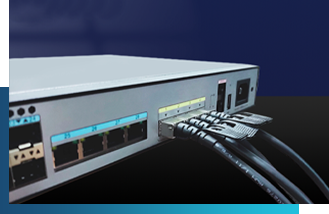
There are some differences between AOC active optical cables and DAC high-speed cables:
①Power consumption: the power consumption of AOC is higher than that of DAC;
②Transmission distance: The farthest transmission distance of AOC is 300M and DAC is 7M;
③Transmission media: the material of AOC is optical fiber but DAC is a copper cable;
④Transmission signals: AOC transmits optical signals while DAC transmits electrical signals;
⑤Price: The price of AOC is much higher than that of DAC because of the optical fibers and lasers;
Generally speaking, DAC high-speed cables are suitable for interconnection distances within 5m and AOC is for 5m-100m.
CWDM optical transceiver is an optical module that uses CWDM technology and is a low-cost WDM transmission technology for the access layer of the metropolitan area network. Using optical multiplexers at the transmitting end, CWDM optical modules can increase the network capacity by transmitting multiple data channels with separate optical wavelengths (1270nm-1610nm) on the same single fiber, and use demultiplexers at the receiving end to decompose into different Wavelength signals are then connected to different devices.